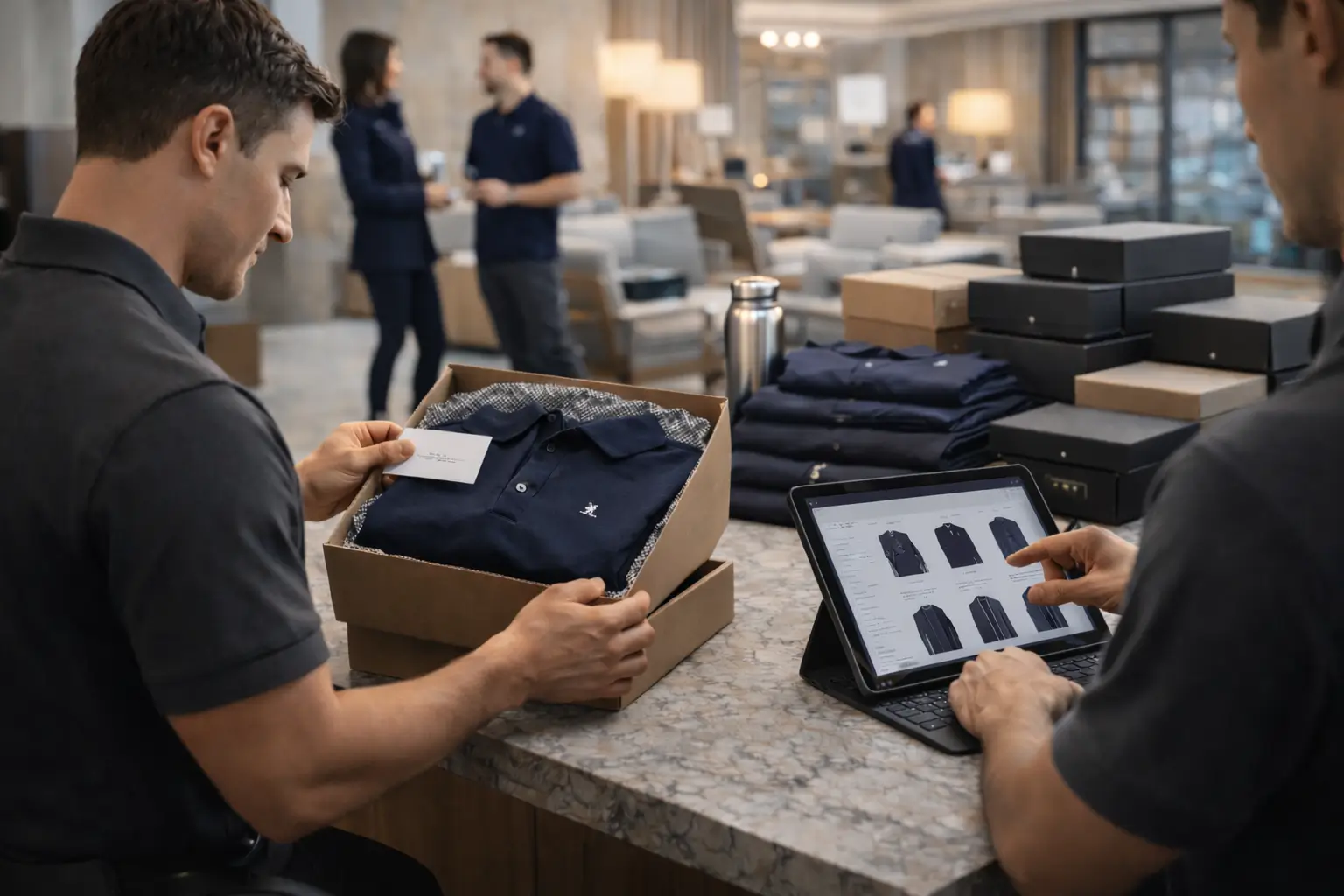
. Company Swag Store Guide | Launch One Employees Use

Company Swag Store Programs

How to Launch a Company Swag Store Employees Actually Use

Launching a company swag store is relatively easy. Launching one that employees continue to use requires more planning — the right products, ordering experience, inventory, and fulfillment all working together.

Curated Product Selection

Brand-Approved Merchandise

Fulfillment & Warehousing

PunchOut Integration

Launch Your Swag Store

Tell us about your program and we’ll build the right store for your team.

Definition

Company swag store: A branded online ordering platform where employees, customers, partners, or approved users can obtain company merchandise. The organization controls products, branding, budgets, permissions, approvals, inventory, payment methods, and fulfillment.

Why Company Swag Stores Matter

Company merchandise is often managed through disconnected emails, spreadsheets, order forms, storage closets, and one-time vendor purchases. A marketing team orders for events, HR sources onboarding gifts, department managers independently purchase apparel, and procurement has limited visibility into spending.

A centralized company swag store brings those activities into one controlled environment. A well-designed store helps an organization:

Maintain consistent brand standards

Give employees easier access to approved merchandise

Establish spending and approval controls

Reduce repetitive administrative work

Manage inventory more accurately

Support remote and multi-location teams

Simplify employee gifting and recognition

Consolidate merchandise purchasing

Improve visibility into product demand

Coordinate fulfillment from a central system

What Is a Company Swag Store?

Also called an employee swag store, online company store, corporate swag store, or branded merchandise store — it is a private or public ecommerce platform built around an organization’s approved merchandise.

Depending on the program, users may:

Purchase merchandise with personal funds

Redeem company-issued points or credits

Use a department budget

Receive gifts selected by the organization

Choose an onboarding item

Order required uniforms

Redeem a service or recognition award

Ship to a home, office, or event location

Behind the store are ten operational systems that must all work together:

Product sourcing

Brand approval

Decoration & production

Inventory planning

User authentication

Budget & approvals

Order processing

Pick & pack

Shipping

Reporting & replenishment

What a Company Swag Store Is Not

A company store should not be confused with a general promotional product catalog. A catalog gives access to thousands of possible products. A managed company store presents a curated selection of items approved for a specific audience and purpose. The platform can also look polished and still fail if its inventory, product mix, procurement workflows, communication strategy, and fulfillment process are weak.

Premium Branded Apparel for Company Stores

Polos, outerwear, and layering pieces your team will actually wear — available with your logo in a range of sizes and colors.

Benefits of an Employee Swag Store

🎯

A Better Employee Experience

Employees see approved products, available sizes, ordering instructions, and shipping options in one place — no email chains, no guessing which department manages apparel.

🎨

Consistent Brand Presentation

A branded company store limits ordering to approved merchandise. Marketing can establish current logo files, brand colors, decoration methods, and product-quality standards.

Operational Efficiency

Instead of manually collecting sizes, addresses, quantities, and payment for every campaign, teams direct employees to the store. Especially powerful for large workforces, remote teams, and frequent onboarding.

🔒

Better Procurement Control

A company store can support standardized pricing, approved suppliers, purchase authorization, and budget limits. PunchOut-enabled stores for company swag, merch, etc. connect directly to your e-procurement environment.

📈

Greater Program Scalability

A scalable store creates a repeatable process for ordering, inventory, fulfillment, and reporting — and can establish different experiences for distinct user groups without a separate program for every department.

🏅

Recognition & Onboarding Support

The store can support new-hire onboarding, service anniversaries, performance recognition, Employee Appreciation Day, and remote-team campaigns through one managed system.

🔗

PunchOut Integration

Looking for a seamless single sign-on option for your branded merch?

Kevins Worldwide company swag stores can operate as fully PunchOut-enabled catalogs — meaning employees access your branded merch store directly from within your existing e-procurement platform (Coupa, SAP Ariba, Jaggaer, and more) without ever leaving their workflow. No separate logins, no manual purchase orders, and full budget control built in.

Bags, Tech & Drinkware for Company Stores

Backpacks, totes, wireless chargers, earbuds, and tumblers employees use at work and at home — all customizable with your brand.

How to Launch a Successful Company Swag Store

A practical guide to building a store employees return to — and internal teams can manage at scale.

1

Define the Store's Purpose

Begin with the business need, not the platform. A store designed primarily for employee purchases will operate differently from one created for uniforms, onboarding, recognition, or departmental ordering.

Use Case Primary Users Typical Ordering Method
Employee merchandise Employees Personal payment or company credit
Onboarding New hires and HR Company-funded redemption
Recognition Employees and managers Award codes, points, or credits
Uniforms Eligible employees Role-based allowance
Departmental merchandise Managers and approved buyers Department budget or purchase order
Events Marketing and event teams Bulk orders with approval
Customer or partner gifts Sales and marketing Approved user ordering

2

Establish Measurable Goals

Define what a successful launch will look like. A launch should not be considered successful merely because the store is live.

Percentage of employees who activate an account

Number of orders per month

Redemption rate for issued credits

Repeat-order rate

Average fulfillment time

Inventory turnover

Out-of-stock frequency

Program participation by location

Customer-service requests per order

Employee satisfaction with available products

3

Identify the Store's Users

Create a clear picture of who will use the store and under which circumstances. Employees should see the merchandise and ordering options relevant to them without navigating unrelated products.

Employee roles

Geographic locations

Remote vs. on-site

Uniform eligibility

Available budgets

Accessibility needs

International shipping

Language requirements

Manager permissions

4

Choose Products Employees Actually Want

The store’s product mix is one of the strongest drivers of adoption. Start with a curated assortment that addresses practical employee needs. Avoid selecting products solely because they are inexpensive or trendy.

Premium T-shirts

Polos

Sweatshirts & quarter-zips

Jackets & outerwear

Headwear

Drinkware

Bags & backpacks

Desk accessories

Technology accessories

Travel items

Wellness products

Workwear & uniforms

Recognition gifts

Seasonal merchandise

5

Build a Balanced Merchandise Assortment

A strong store typically includes products across several price points and purposes. Prioritize quality, usefulness, inclusive sizing, and alignment with the workplace.

Merchandise Tier Purpose Examples
Everyday essentials Frequent use and accessibility T-shirts, caps, tumblers
Mid-tier merchandise Quality and versatility Polos, sweatshirts, backpacks, drinkware
Premium merchandise Recognition and high-value moments Outerwear, branded tech, premium bags
Recognition items Milestone and achievement gifting Custom awards, curated kits, gift sets

6

Plan Inventory and Fulfillment

Inventory and fulfillment directly determine whether employees return to the store. Out-of-stock items, slow shipping, and size limitations are the most common reasons employees stop using a company store.

In-Stock Inventory

Warehoused merchandise available for immediate order — best for uniforms, high-frequency items, and onboarding kits.

On-Demand Decoration

Items produced when ordered — reduces inventory risk for lower-volume products and seasonal merchandise.


Drop Shipping

Products shipped directly from the supplier — useful for special items and when warehouse space is limited.

Hybrid Model

A combination approach — popular core items are warehoused while specialty and premium items are produced on demand.

7

Configure Budgets, Permissions, and Ordering Rules

A well-configured store connects merchandise access to defined organizational rules — ensuring employees get what they are entitled to, no more and no less.

Individual spending caps

Department budget pools

Manager approval workflows

Role-based product access

Points or credit systems

Allowance resets (annual, quarterly)

PunchOut procurement integration

Purchase order support

8

Promote the Store Internally

A store that employees do not know about cannot drive adoption. Internal promotion is not optional — it is a launch requirement. Plan communication across multiple channels and repeat it regularly.

→  All-hands or department announcements

→  Onboarding program inclusion

→  Internal newsletter features

→  Manager communication guides

→  Intranet or employee portal placement

→  Reminder emails during key seasons

→  Recognition program tie-ins

→  Visual examples of available merchandise

Kevins Worldwide Company Stores

More than 900,000 Products to Choose From. One Managed Platform for Your Company.

From curated onboarding kits to large-scale uniform programs, Kevins Worldwide builds and manages company stores that employees actually use.

Company Swag Store FAQs

How much does it cost to set up a company swag store?

Costs vary based on platform complexity, inventory investment, customization requirements, and fulfillment setup. Kevins Worldwide works with organizations across a range of budgets — from simple branded stores to fully managed enterprise programs. Contact us to discuss your specific requirements.

A basic store with a focused product assortment can typically launch within two to four weeks. More complex programs involving inventory build, PunchOut integration, multi-user configurations, or custom decoration may require additional time. We will establish a realistic timeline based on your program needs.

The most successful stores balance everyday essentials (t-shirts, caps, tumblers) with mid-tier and premium merchandise (polos, outerwear, bags, tech accessories). Products that employees use regularly — at work, at home, or in transit — tend to have the highest adoption rates.

Yes. Kevins Worldwide supports PunchOut-enabled stores that integrate directly with major e-procurement platforms including Coupa, SAP Ariba, Jaggaer, Oracle, and others. Employees access the store from within your procurement environment and return the cart for purchase-order processing.

Kevins Worldwide offers complimentary warehousing for in-stock items, on-demand decoration for lower-volume products, and hybrid models that combine both approaches. Our fulfillment team handles pick-and-pack, shipping, and inventory replenishment.

Yes. Stores can be configured with different catalogs, budgets, and permissions for distinct user groups. Remote employees, field teams, corporate staff, and franchise locations can all receive a tailored experience within the same platform.

A promotional product catalog provides access to a broad product selection. A managed company store presents a curated assortment approved for a specific audience and purpose — with defined ordering rules, brand controls, and fulfillment processes behind it.

Ready to Launch a Company Swag Store?

Kevins Worldwide designs, sources, builds, and manages branded company stores for organizations of all sizes — from startup onboarding kits to enterprise-wide uniform and recognition programs.